
Department of Law Enforcement Home Page
DEPARTMENT OF LAW ENFORCEMENT
KA’OIHANA HO’OKŌ KĀNĀWAI

The Department of Law Enforcement is the centralization of state law enforcement functions in Hawaii with the goal of enhancing public safety. This involves enforcing the Uniform Controlled Substance Act and investigating violations of relevant statutes and rules. The department oversees various administrative aspects, including program planning, budgeting, accounting, procurement, and human resources, adhering to applicable laws and regulations.
As the primary law enforcement entity, the department aims to preserve public peace, prevent crime, and protect individuals and property. It administers statewide programs to ensure public safety, safeguard state property, and enforce laws. Additionally, the department conducts criminal investigations involving its own employees or against its property.
A significant focus is placed on the development, coordination, and implementation of a comprehensive Homeland Security program for the state. This involves collaboration with federal, state, county, and private sector stakeholders to address security concerns and ensure the safety of the state of Hawaii.
FREQUENTLY CALLED NUMBERS
| Sheriff Division: (808) 587-5002 | Narcotic Enforcement Division: (808) 837-8470 | Criminal Investigator Division: (808) 587-5050 |
| Sheriff Records: (808) 587-5121 | Human Resource Office: (808) 587-5036 | Report Scam Calls: (808) 586-1352 |
| Click to Request Special Duty Officers | Process Servers: 2025.10.15-Process-Server-List.pdf |
DISCLAIMER:
Process servers are not law enforcement officers and are not DLE’s employees. Do not call DLE over any dispute or complaints over a process server. Process Servers are a private business and disputes must be taken up with them.
SILVER Alert – Report an Elderly or At-Risk Missing Person


AG Crime Reporting & Tip Line – please text or call (808) 427-3323
Agricultural crimes—including theft of livestock, equipment, or crops—cause significant losses for Hawaii’s farmers and ranchers. These crimes not only impact local food security and economy, but also the sustainability of island agriculture.
If you see or suspect agricultural crime, speak up. You can remain anonymous.
Why It Matters:
Ag crimes in Hawaii include the theft of cattle, crops, tools, and vandalism. Every report helps law enforcement track down offenders and protect our ag communities.
Together, we can help protect Hawaii’s land, food, and future.

To report gun crimes, please text or call (808) 427-4018
All calls will be kept confidential. You may remain anonymous. Please call or submit tip information below to include the following:
- The names of the people involved.
- The descriptions of the people involved.
- Where the people involved may be located?
- What kind(s) of guns are involved?
- The license plates and descriptions of any vehicles involved.
- Detailed information about gun crimes that can assist investigators.
- If you desire to be called back, your name and telephone number
- All tips are anonymous unless the submitter provides their contact information.
In case of an emergency, please call 911

To report illegal fireworks sellers, please call (808) 427-4018
All calls will be kept confidential. You may remain anonymous. After-hours and on weekends, please leave a detailed message about illegal fireworks sellers including:
- The names of the people involved.
- The descriptions of the people involved.
- Where the people involved may be located?
- What kind(s) of fireworks being sold?
- Where the illegal fireworks are being sold?
- The license plates and descriptions of any vehicles involved.
- Detailed information about any shipments of illegal fireworks into Hawaii.
- If you desire to be called back, your name and telephone number
TO REPORT FIREWORKS NOISE OR FIREWORKS BEING ILLEGALLY SET OFF, please call the police department at 911.
Go to: GetSaferWatch.com to Download the free app today and get the real-time updates from DLE.

BEWARE CALLERS IMPERSONATING LAW ENFORCEMENT
The DLE is warning the public of a missed jury duty scam where callers who impersonate law enforcement officers tell the public they have missed jury duty, or that there is a warrant for their arrest. They then tell the public that they owe money. THIS IS A SCAM! NEVER send any money, bit coin, or provide financial information to people you do not know or to people over the phone!!
CLICK HERE FOR MORE INFORMATION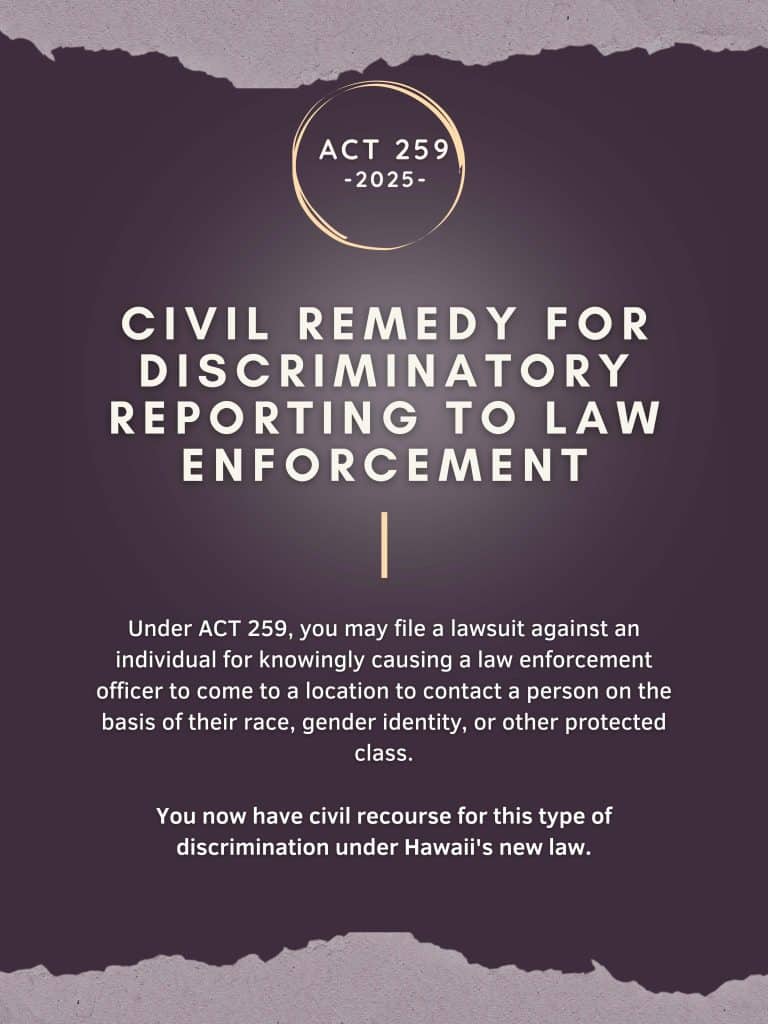
Civil Remedy for Discriminatory Reporting to Law Enforcement – Effective September 1, 2025
Hawai‘i’s new law — Act 259 — legislation aimed at preventing the misuse of emergency services to target individuals based on race, gender identity or other protected class officially went into effect across the state September 1, 2025. Signed into law by Governor Josh Green on July 1, 20225, Act 259 establishes a civil remedy for individuals harmed by discriminatory reporting to law enforcement.
WHAT YOU SHOULD KNOW:
- A lawsuit may be filed against anyone who knowingly causes a law enforcement officer to come to a location to contact another individual with the intent to harass, humiliate or infringe upon a person’s rights based on a protected class.
- Protected classes include race, color, ancestry, ethnicity, national origin, place of birth, sex, age, religion, disability, sexual orientation, gender identity or expression.
- Affected individuals may seek relief in civil court, including injunctions, damages (no less than $1,000), punitive damages, coverage of attorneys’ fees and costs.
Learn More:
Need Help In Another Language?
For 廣東話/广东话 , 國語/普通话 , Kapasen Chuuk , ʻŌlelo Hawaiʻi , Ilokano , 日本語 , 한국어 , Kajin M̧ajeļ , Gagana Samoa , Español , Tagalog , ภาษาไทย , Tiếng Việt , Visayan
Click Here2025-0003 Statewide Illegal Fireworks Task Force Annual Report
Mission
To stand for safety with respect for all by engaging in just, transparent, unbiased and responsive Law Enforcement, to do so we the spirit of Aloha and dignity and in collaboration with the community; and maintain and build trust and respect as the guardian of constitutional and human rights.
Department Goals
To protect the individual and property from injury and loss caused by criminal actions by providing and coordinating services, facilities, and legislation to preserve the peace; enforce specific laws, rules, and regulations to prevent and control crime; prevent and deter crimes; and serve the legal process.
Core Values
RESPECT: Treating everyone with Aloha, honoring the rights of all individuals
INTEGRITY: As a law enforcement agency of character and principle we are guided by a moral compass in all of our decisions
COLLABORATION: Build strong partnerships with the community and first response agencies for addressing community-wide challenges that impact community welfare
DIVERSITY: We embrace the strength of diversity in our employees and our communities.
Uniform Information Practices Act (UIPA) Request
If you are seeking access to government records from the Department of Law Enforcement under the Uniform Act, click below.
Request to Access Government RecordsJoin, Work And Succeed.
DEPUTY SHERIFFS
Deputy Sheriffs are the core law enforcement staff of the Sheriff Division.
- State Sheriff: the head of the Sheriff Division. They are exempt from civil service and serve at the pleasure of the Director.
- First Deputy Sheriff: the second-in-command of the Sheriff Division, they assist the Sheriff with management of the division and all of its activities.
- Deputy Sheriff V: a branch Captain, responsible for all operations, activities, and administrative matters of their branch.
- Deputy Sheriff IV(Lieutenant): the second level full supervisor who manages a major law enforcement function with multiple subordinate supervisors.
- Deputy Sheriff III(Sergeant): the first level supervisor who is engaged in field supervision of their assigned work shift.
- Deputy Sheriff II: the regular working level.
- Deputy Sheriff I: a trainee level, deputies of this rank are still enrolled in training in a law enforcement academy.
INVESTIGATORS
Investigators have the powers and privileges of police officers with statewide jurisdiction to effect arrest and conduct investigations.
- Investigator VI(Detective Lieutenant): the full management level, responsible for all operations, activities, and administrative matters of their major organizational component.
- Investigator V(Detective Sergeant): an expert working level who, depending on assignment, may also have supervisory responsibilities. This rank is divided into two distinct types:
- Type A: a supervisor who has full responsibility of a specific investigative program (e.g. welfare fraud) and has at least one subordinate of the Investigator IV level (type A or C).
- Type B: an investigator who conducts complex investigations falling within a variety of jurisdictions and program areas, and where facts and evidence are not generally easily found.
- Investigator IV: an advanced working level who, depending on assignment, may also have supervisory responsibilities. This rank is divided into three distinct types:
- Type A: an investigator who conducts complex investigations, but which are related to only one program area (e.g. welfare fraud).
- Type B: one or two investigators who have full responsibility of a small investigative program.
- Type C: a supervisor who supervises, and conducts, investigations of violations which are expected to involve only a few or no controversial issues, and where facts and evidence are easily found through official records.
- Investigator III: the first regular working level, they conduct investigations of violations which are expected to involve only a few or no controversial issues, and where facts and evidence are easily found through official records.
- Investigator II: advanced trainee level, they work with higher level investigators on cases which are limited in nature and scope.
- Investigator I: first trainee level, they mainly observe higher level investigators while learning applicable laws, regulations, and processes relating to their duties.